
Current research indicates “an individual’s learning style refers to the preferential way in which the student absorbs, processes, comprehends and retains information.” Essentially, “VARK is an acronym that refers to the four types of learning styles: Visual, Auditory, Reading/Writing Preference, and Kinesthetic.” Many learning style surveys omit the Reading/Writing Preference leaving it the typical three: visual, auditory, or kinesthetic. It is important to note, although a student or adult has a preference for one particular style over the other, it is also important that they practice outside their comfort zone because there may be times when their learning style may be constrained by outside forces.
Every teacher should, theoretically, strive to adapt their lesson plans to incorporate each of these four areas as often as possible to ensure all students’ learning modalities are covered. In fact, according to Fleming and Baume (2006):
- Students’ preferred learning modes have significant influence on their behavior and learning.
- Students’ preferred learning modes should be matched with appropriate learning strategies.
- Information that is accessed through students’ use of their modality preferences shows an increase in their levels of comprehension, motivation and metacognition.
“Identifying your students as visual, auditory, reading/writing or kinesthetic learners, and aligning your overall curriculum with these learning styles, will prove to be beneficial for your entire classroom. Allowing students to access information in terms they are comfortable with will increase their academic confidence” (“Learning Styles”, 2017).
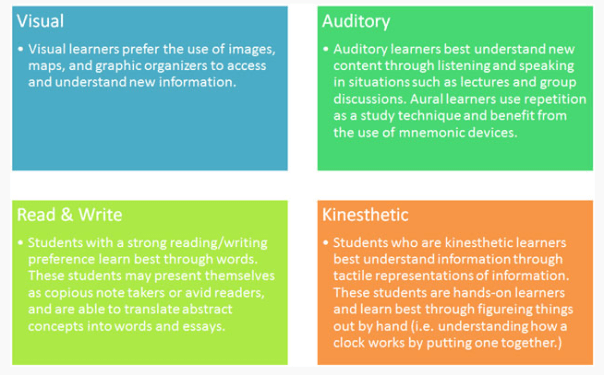
Understanding how they learn best, enables a student to adapt his or her current study habits to include methods previously unrealized as potentially successful. This can be a real eye-opener to a student who has struggled in school academically simply because they are more kinesthetic and most instruction is given visual or auditory modalities.
In my classes, I often use what I call the Around the Room Learning Lab. It incorporate eight different learning stations: Read It! Write It! Explore It! Organize It! Watch It! Research It! Assess It! Illustrate It! and Write It!. Credit for this goes to Chris Kesler on Teacher Pay Teachers who introduced me to this idea. I have used many of his labs, and having become familiar with them, have been redesigning them to incorporate deeper cognitive questions and/or thinking, or to emphasize a different aspect of the content. Mr. Kesler does an amazing job in creating these learning labs, which are great at getting the students familiar with the facts, simple DOK levels 1 and 2 information. I have been redesigning some of them to incorporate more DOK 3 and 4 levels of thinking. What is especially great about the labs is that the students are moving around, collaborating, discussing academic concepts, reading academic material, watching academic videos, and illustrating their visualization of academic content.
Once the students have gone through the basics, I am ready to put them through the paces with a scientific lab set up requiring a hypothesis, materials, procedures, data analysis, and results.
Works Cited
Fleming, N., and Baume, D. (2006) Learning Styles Again: VARKing up the right tree!, Educational Developments, SEDA
Ltd, Issue 7.4, Nov. 2006, p4-7.
Learning Styles. (2017). Retrieved March 25, 2017, from https://teach.com/what/teachers-teach/learning-styles/
Othman, N., & Amiruddin, M. H. (2010). Different Perspectives of Learning Styles from VARK Model. Procedia – Social and Behavioral Sciences, 7, 652-660. doi:10.1016/j.sbspro.2010.10.088
 Just A Lynn Minute