All posts by Lynn Munoz

Unknown's avatar

About Lynn Munoz

Christian Wife, Mother, Daughter, Sister, Friend Teacher

Gemklocx Lab

Thank you AVID Science 1, a summer conference I took recently.  This was a wonderfully ingenious lab I did with my Geoscience students, both periods 1 and 2.  It does require quite a bit of set-up and some rather ordinary materials.  Once you are organized, it works out great, as long as the students follow the rules of the lab.

Materials:

  • 2 small paper plates
  • 4 twist ties
  • 2 straws
  • Aluminum foil 12 x 12
  • 1 small paper cup
  • 2 paper clips
  • 3 rubber bands
  • 1 sheet of paper
  • 8 cm of tape

Procedures

The students each received a handout (provided by AVID)  Think It-Build It-Write It-The Gemklocx, which explained the procedure, in addition to the PowerPoint and my oral directions.

There were two main parts of the lab, which is designed to teach students the importance of following EXACT procedures during lab experiments.

First, each student partners with another student forming a team.  Each team receives one set of materials to create and build a model of their own originality.  The time limit is 20 minutes.  At the same time, each team MUST record their procedure, item by item so that the next team can recreate their EXACT model without being able to see it.  All materials must be used and the students were not allowed to add any materials.

Second, the teams were told to hide their models so the other teams could not see them.  Each team was given the exact same materials as previously in addition to the written procedures provided by one of the random teams.  These teams had only 10 minutes to recreate the original model of the first team.

It was one of the best labs.  It was early in the year, and the students were so engaged in the entire process.  They loved created something their own.  Their follow-up reflections regarding the lab concept, procedures, ease and/or difficulty revealed the majority of the students believed the writing of the procedures specific enough for another team to follow was, indeed, the most difficult part.  I look forward to doing it again next year.

Do Sharks Prefer Red?

My classes tend towards utilizing a lot of “real-life” happenings in the world.  It is no surprise that one of my favorite labs had the students watching a short clip from the popular television show Mythbusters where the team uses the scientific method to debunk the idea that sharks prefer the color red.  To view the video, click here: SHARKS

I honestly cannot recollect where I got this lesson plan or idea from.  I checked all my files and could only find the excel worksheet where I use the Mythbusters: Do Sharks Prefer Red? as the backdrop for the lesson plan on the Scientific Method.  If anyone out there knows where I found it, I would truly appreciate a comment so I can give the proper credit.

I did create or recreate a worksheet that starts at the lower level of thinking.  First, we just watch the short 4 or 5 minute video clip.  Then, the students answer some basic “what did you see” kind of questions.  Then, the students have to watch the video a second time and more carefully detail the scientific method stages as they are being used in the video using the video itself as evidence.  Following that, the students take to the deeper level and are required to come up with their own myth to bust and design a scientific method experiment to test it.

These types of lessons really engage my students because they are so “into” media: music, video, and who isn’t into sharks?


Scientific Method Project

So excited, the students and I had been learning all the different parts of the scientific method, analyzing it, dissecting it, and now it was time to put them in the driver’s seat, so to speak.

Each student had to create their own flow chart poster board describing an experimental process, from title, hypothesis, all the way to conclusions.  It was really exciting.  I provided the following example:

Growth Mindsets

Growth Mindsets is a very hot topic in education these days.  Essentially, individuals who believe they have the power to improve their lives, education, skill sets, and relationships have an open/growth mindset.  Something good happens and it the result of good old-fashioned hard work.  It was not luck.  It was not because they are geniuses (although there are some super-bright individuals in the world).  No.  It is because that personally legitimately decided to put in the effort, follow up, and if that did not do the trick, they sought help.  Eventually, the individual knows they can and will succeed.

This is applicable to everything; at this time I am not an excellent drawing artist.  That does not mean I cannot get better.  I can purchase some books, some artistry tools, watch some online tutorials, or even find a mentor.  Will I ever paint or draw a Picasso?  Probably not, but I bet I could become a pretty good artist.

On the other hand, Fixed Mindsets are very common as well.  These individuals believe that to be good, really good at something (sports, academics, finances, etc.), they need to be talented or blessed with God-given gifts.  If a student gets straight A’s it is diminished by those who consider it due to natural ability.  Students work hard, study harder, and have real strategies for doing well in their courses.  Consider for a second, baseball players in the major leagues.  If a person identifies one of the baseball players as just lucky, being in the right place at the right time, it sort of diminishes all of the hard work a baseball career requires, doesn’t it?

Unfortunately, for those that believe you either have it or you don’t, life can be very hard indeed.

Myself, I had a growth mindset before the phrase was even coined.  One of my personal experiences using a growth mindset, without even realizing it, occurred when I was only 15, going into my second semester of my junior year at Westminster High School.  I had moved a lot as a kid, but my parents managed to keep me in the same school district from 7th to 12th grade.  I tested highly in almost everything and was put in the honors/AP tract.  My eighth grade math teacher was not particularly impressed with my math grade in 8th grade.  Of course, I sat in the back, did not wear my glasses, and rarely understood what she was saying.  I did not dwell.  Based on the teacher’s recommendation, I was put in Algebra A, B, C, D.  Each took one semester equivalent to my freshman and sophomore years in High School.  Mind you, all the rest of my classes were honors and AP and I was getting good grades in everything.

When school restarted after Christmas break in my Junior year, many of friends in the honors or AP classes were all lit up about being a “Distinguished Scholar.”  I did not know what this was, and I did not know why I was not in the know.  Being forthright, even then, I went to my academic counselor and asked what was going on with this Distinguished Scholar award, as it was apparently a “big” deal.  I was told I would not and could not graduate with that honor.  You see, only students who took the honors/AP courses AND successfully passed pre-calculus as a Senior could earn the award.  The counselor essentially told me it was an impossibility because as a Junior I was taking Geometry.  As a Senior I would go on to Algebra 2.

I did not even think twice about it.  I asked her to explain exactly what would have to happen for me to earn the award.  She was pretty negative about the idea, but indicated if I took Algebra 2 at the local junior college and passed with an A, and took Trigonometry over the summer at the junior college and passed it with an A, she would agree to put me in Pre-Calculus as a Senior.

That is exactly what I did!  In fact, Algebra 2 at the college was so easy.  I struggled more with Geometry.  Trigonometry was a hoot.  I still remember taking the bus to the beach after my morning class at Goldenwest College.  I brought my Trigonometry book, studied, and successfully passed.  In fact, I passed both of the classes with an “A.”  Pre-calculus was super hard.  My best friend, Mina, tutored me that year and I passed with a C for both semesters, but I passed!  On a side note, because I took those two math classes at a junior college, I did not have to take math in college for my Bachelor’s degree.  Cool, right?


Quote by David Bly

A great many of my class journals follow a growth minded theme.  They are typically famous writers, authors, or people of the world that resonate.  In common core fashion, I have the students read the quote silently, and respond to it for 10 minutes in their written interactive journals.  The students are aware that other than spot checking the journals to ensure they are complete and meet the minimum length requirement of 1/2 page, I will not invade their privacy and read their private thoughts unless they request I do so.

The students often ask me to do the journals when they do them, and I happily comply because I enjoy writing.  The best part is that after they have me read mine, they are eager to share a few of their own.  Some of the students really see the depth and meaning behind the quotes.  Other times, I have to explain the quote a little beforehand because the students do not understand the meaning, context, or vocabulary.

This particular quote was pretty straightforward, although not very appreciated by the students.  The students expressed a vocal desire to remain “a kid” and that they are “not in a hurry” to grow up as previous generations.  I am not entirely sure how this happened.  Perhaps, previous generations wanted their children to have it easier than they did, and so we created a society that quite literally does not want to grow up.  I see freshmen fight it all the time.  It is almost as if they believe that if they fail in school it will slow down the process.  It breaks my heart sometimes, but having come from a difficult background myself, I grew up fast and learned early, if you want any success you have to go out and grab it.  You have to look after your future and goals.  Probably why I have spent most of my life either teaching in school, or going to school, or both.

Learning Styles

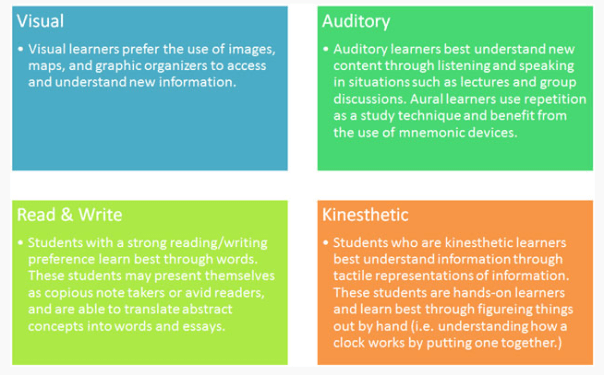
Current research indicates “an individual’s learning style refers to the preferential way in which the student absorbs, processes, comprehends and retains information.”  Essentially, “VARK is an acronym that refers to the four types of learning styles: Visual, Auditory, Reading/Writing Preference, and Kinesthetic.”  Many learning style surveys omit the Reading/Writing Preference leaving it the typical three: visual, auditory, or kinesthetic.  It is important to note, although a student or adult has a preference for one particular style over the other, it is also important that they practice outside their comfort zone because there may be times when their learning style may be constrained by outside forces.

Every teacher should, theoretically, strive to adapt their lesson plans to incorporate each of these four areas as often as possible to ensure all students’ learning modalities are covered. In fact, according to Fleming and Baume (2006):

  • Students’ preferred learning modes have significant influence on their behavior and learning.
  • Students’ preferred learning modes should be matched with appropriate learning strategies.
  • Information that is accessed through students’ use of their modality preferences shows an increase in their levels of comprehension, motivation and metacognition.

“Identifying your students as visual, auditory, reading/writing or kinesthetic learners, and aligning your overall curriculum with these learning styles, will prove to be beneficial for your entire classroom. Allowing students to access information in terms they are comfortable with will increase their academic confidence” (“Learning Styles”, 2017).

Vark

Understanding how they learn best, enables a student to adapt his or her current study habits to include methods previously unrealized as potentially successful.  This can be a real eye-opener to a student who has struggled in school academically simply because they are more kinesthetic and most instruction is given visual or auditory modalities.

In my classes, I often use what I call the Around the Room Learning Lab.  It incorporate eight different learning stations: Read It! Write It! Explore It! Organize It! Watch It! Research It! Assess It! Illustrate It! and Write It!.  Credit for this goes to Chris Kesler on Teacher Pay Teachers who introduced me to this idea.  I have used many of his labs, and having become familiar with them, have been redesigning them to incorporate deeper cognitive questions and/or thinking, or to emphasize a different aspect of the content.  Mr. Kesler does an amazing job in creating these learning labs, which are great at getting the students familiar with the facts, simple DOK levels 1 and 2 information.  I have been redesigning some of them to incorporate more DOK 3 and 4 levels of thinking.  What is especially great about the labs is that the students are moving around, collaborating, discussing academic concepts, reading academic material, watching academic videos, and illustrating their visualization of academic content.

Once the students have gone through the basics, I am ready to put them through the paces with a scientific lab set up requiring a hypothesis, materials, procedures, data analysis, and results.

Works Cited

Fleming, N., and Baume, D. (2006) Learning Styles Again: VARKing up the right tree!, Educational Developments, SEDA
Ltd, Issue 7.4, Nov. 2006, p4-7.

Learning Styles. (2017). Retrieved March 25, 2017, from https://teach.com/what/teachers-teach/learning-styles/

Othman, N., & Amiruddin, M. H. (2010). Different Perspectives of Learning Styles from VARK Model. Procedia – Social and Behavioral Sciences, 7, 652-660. doi:10.1016/j.sbspro.2010.10.088