Category Archives: Journals

Fair v. Equal

Last week my students in Health cried out in despair at the thought that one student was being treated less “equally” as another.  I brought up the discussion of fair v. equal and after a few minutes it became rather clear that as teens, they were having a difficult time understanding the dilemma associated with these terms.  So, I created a reflective piece for them to consider.  There were multiple scenarios provided and they needed to pick out which would be “fair” and which would be “equal.”  Following that was a series of questions, that I hoped would be considered and answered thoughtfully.  A copy of the assignment is attached for reference purposes (fair-v-equal)

One of my responsibilities as a Health instructor of young 9th grade teens is to impart upon them critical thinking, empathy, perspective, decision-making skills, and responsibility in all things health-related.  All things health-related is pretty expansive and stretches far beyond abstinence from sex, drugs, and other risky behaviors.  Teaching tolerance and understanding are probably the most difficult concepts for concrete teens to wrap their minds around.  They very often do not see the consequences of their decisions or actions until they are experiencing them.  I remember vividly my black and white concrete thinking of my teen years all too well.

Fair

Merriam-Webster defines “fair” in no fewer than ten different ways; most relevant to this post are: “6(a) marked by impartiality and honesty : free from self-interest, prejudice, or favoritism; (b): conforming with the established rules : allowed; 10 sufficient but not ample : adequate.”

Equal

Merriam-Webster defines “equal” in quite a number of ways as well.  Those most relevant to this post are: “(1)(a) : of the same measure, quantity, amount, or number as another (2)(a) : equivalent; (b) : like in quality, nature, or status; (c) like for each member of a group, class, or society; (3) regarding or affecting all objects in the same way : impartial.”

The responses I received were varied, but the gist was that they still believed that life should be equal over fair seemingly because if one person gets treated one way, they want to be treated that way as well.  Yet, when faced with a negatively equal situation, they were quite quick to jump over to the fair side of things.  Sadly, few took the time to consider the many significant considerations that impact whether life is “fair” or “equal.”  For instance, they were quick to argue only students who misbehave should receive punishment in a class, yet they refuse to come forward and report to the teacher who the jokester kids are out of blind loyalty to their peers, leaving the teacher with few all or none equal options, rather than the preferable fair options.

Further, the students have not quite connected with the reality of how deeply some beliefs run, preventing fair or equal treatment for all.  For example, consider the inequality in pay for women v. men.  According to The Gender Wage Gap: 2015; Annual Earnings Differences by Gender, Race, and Ethnicity – See more at: http://www.iwpr.org/publications/pubs/the-gender-wage-gap-2015-annual-earnings-differences-by-gender-race-and-ethnicity#sthash.tBFSYiPv.dpuf:

The ratio of women’s and men’s median annual earnings was 79.6 percent for full-time/year-round workers in 2015. This means the gender wage gap for full-time/year-round workers is 20.4 percent. The ratio of women’s and men’s median annual earnings did not improve significantly during the last year, and has not seen a statistically significant annual increase since 2007.

Economy is another primary consideration that is often unconsidered by teens because they have as yet the experience of pinching pennies to pay this bill or that over something they desire more.  They often still believe money simply arrives like magic from atm machines and there is some never-ending supply for everyone, except them of course. Sometimes this is because the parents are still sheltering the teens from the harsher realities of financial responsibility and sometimes, they are fortunate that they do not have very harsh financial realities.

Interestingly, none of the students to date, even looked up the terms for comparison.  When I began grading their responses this evening, I found myself unable to put in comments playing devil’s advocate to their scenarios – poking holes in their tidy black and white thinking.  I am very fortunate to teach health because so much of life revolves around our social, physical, and mental/emotional health.  Plus, it is just plain fun to provide numerous “real” examples that become teachable moments almost every day.  I have as yet to have any student of mine say they did not learn a tremendous amount in my class, despite the fact that I am neither an easy “A,” and I require them to do multiple research-type projects.  By the end of the semester, they have come to realize that Health was probably one of the most important foundational classes they have or will ever take… not to mention the potential for saving their lives, many times over.

Works Cited

Equal. (n.d.). Retrieved February 1, 2017, from https://www.merriam-webster.com/dictionary/equal

Fair. (n.d.). Retrieved February 1, 2017, from https://www.merriam-webster.com/dictionary/fair

Hegewisch, A., & DuMonthier, A. (2016, September). IWPR Publication. Retrieved February 01, 2017, from http://www.iwpr.org/publications/pubs/the-gender-wage-gap-2015-annual-earnings-differences-by-gender-race-and-ethnicity
Don’t give up!

Another of my favorite journal quotes, submitted by some random author that likely did not realize how inspirational their words would be to future individuals, students and adults alike.

The growth mindset is certainly not just for children to understand and foster within themselves, but there is a tide of working force adults out in the world, working themselves to death, feeling far away from their dreams, feeling perhaps they should just give up.  It would seem easier.  But, that is where this idea really gets its magical properties because everyone loves the underdog, everyone knows the big win is just around the corner, and everyone knows someone that did not quit and got it right!

For some, it could be giving up on finding the “one.”  For others, it could be giving up on their dream of going to college, getting a graduate degree, or even buying a house.  Apparently, we have differing levels of growth mindset for different parts of our lives.  Hard to imagine, right?

Yet, my best girlfriend, Sunny, is and has been an amazing RN for over 20 years.  It just seemed she always getting a new nursing position.  She did not like this about that job, one clinic closed, another clinic changed specialties, one employer was building a new healthcare clinic, but after a year they still could not give her enough hours, on and on.  I thought it a little odd so I did a little spelunking on the Internet and it turns out the turnover rate for RNs is pretty steep.  One study indicated approximately 17.5% of newly licensed RNs leave their jobs within one year, and worse, up to 33.5% within two.  What was truly mind-boggling is Sunny’s ultimate confidence in her abilities as a nurse.  She KNOWS she is a great nurse.  Every time she needed her resume updated I would help her and be worried for her.  She would tell me over and over, she was not worried, she would find another job because she was THAT good!  She has always been right.

This same woman, a woman I might add with such loyal and bonded girlfriends that we get together across time and space to spend at least one day a year together, was fearful she would not ever find love.  I would question her belief, again, knowing myself how much she has to offer.  She is beautiful, kind, gentle, great at negotiations, can sing like an angel, has many great friends, and a heart for Christ.  But, between her family upbringing and being divorced twice, she had a hard time believing in herself as prime love material. Spoiler alert:  Sunny is currently in a committed, mutually loving romantic relationship with a great guy, someone she has known since high school.  

Then, there is me.  I also work in an industry (teaching) with a known high turnover rate ranging from approximately 17% in the first three years to 30% at five years to greater than 50% by ten years (Long, 2015; Strauss, 2015; Westervelt, 2016).  I also KNOW I am a good teacher.  My students learn to think critically – for themselves, my students respect me, are caring towards me, and the most obvious indicator is they try harder to do better.  It goes without saying, I am the die-hard type that keeps going, professional development, one masters, another on the way.  But, leaving a position is scary for me.  Even knowing what I know AND being a growth-minded person, there is still fear in the back of my mind, in the the pit of my belly.  It is ironic, my growth mindset philosophy is so strong when it comes to my students.  I tell them all the time, “you CAN do it.”  You can BE whoever you want to be.  You can do whatever you put your mind to do.  Your mind and effort in sync will get the job done – you just need to be “all in.”  I am so passionate about my belief for my students that when they catch themselves saying, “I can’t” they quickly add “yet.”  

On the other hand, between my family upbringing and divorce record you would think I would be a little shaken about matrimony and my romantic possibilities.  Instead, after the second divorce I said “never again.”  I just had a blast doing things had never done in my 20’s because I was married.  I learned how to country line dance.  I found my faith.  I found “myself.”  That lasted about six months (not the finding “myself” part, the “never again” part) when I met my current husband of 17 years!  It just was not overly concerned about being alone.  I was not worried I would not find the “one” and my life would be over.  I was confident my life was on track and would be fine, husband or not.

It would appear that the growth-mindset concept is another ongoing process in figuring out our human psyche – growth, motivation, effort = success??  Perhaps, that is where friends, colleagues, and mentors play a role.  When Sunny felt down about romance, I was there to perk her up and remind her of all she has to offer the world.  Vice versa, when I feel job concerns, she reminds me of everything I have to offer the students.  My husband tells me too, but does he really count?  I’ve heard the saying, “Happy Wife, Happy Life.”   So, how much is truth and how much is the mantra looping through his head?

Works Cited

Long, C. (2015, June 06). Teacher Turnover Is Much Lower Than You Probably Think. Retrieved March 27, 2017, from http://neatoday.org/2015/05/13/teacher-turnover-is-much-lower-than-you-probably-think/

One in Five Nurses Leave First Job Within a Year. (2017, February 09). Retrieved March 27, 2017, from http://www.rwjf.org/en/library/articles-and-news/2014/09/nearly-one-in-five-new-nurses-leave-first-job-within-a-year–acc.html

Strauss, V. (2015, June 12). Why so many teachers leave — and how to get them to stay. Retrieved March 27, 2017, from https://www.washingtonpost.com/news/answer-sheet/wp/2015/06/12/why-so-many-teachers-leave-and-how-to-get-them-to-stay/?utm_term=.2c39f4806d08#comments

Westervelt, E. (2016, September 15). Frustration. Burnout. Attrition. It’s Time To Address The National Teacher Shortage. Retrieved March 27, 2017, from http://www.npr.org/sections/ed/2016/09/15/493808213/frustration-burnout-attrition-its-time-to-address-the-national-teacher-shortage

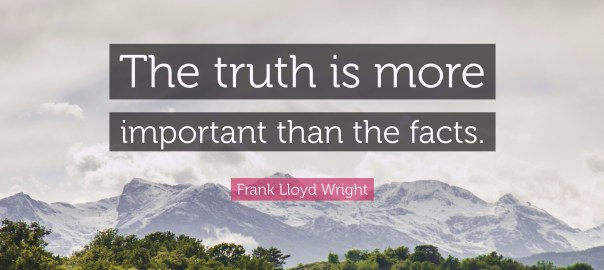
Truth

The students struggled mightily with this quote.  Some of the more flippant students tried to take the easy way out and claim that the truth is the facts and facts are the truth.  Rather than dissuade them immediately, we moved onto on regular science lesson (this was just the journal to capture their mindset).

The rest of class went by without any issues.  During the next class I broached the topic again of when it would be possible that the truth is more important than the facts.  I prodded them with a few examples because ultimately it becomes about semantics, vocabulary, ethics, character, and even social norms in some instances.

Example 1: A young couple adopts a baby boy, and were then subsequently surprised by their own bundle of joy, a baby girl about a year later.  These siblings were raised their entire life as brother and sister, fighting over television shows, arguing through their teens, and enduring puberty as teens attending the same high school.   When the girl reaches 18 and the boy just a year older, they decide to run away and elope.  Is that okay? Why or why not?  

The students were enraged at the idea that this could happen, but I calmly countered with why?  They may be legally brother and sister, but biologically they are not.  Why does it matter so much?  Then, the students realize, they have to look deeper into the meanings of what is really being asked.  In this instance, because the children were raised together, their eloping would be a violation of our social norms against incest within the family.

Example 2: Teachers in the hotseat.  I ask the students how do they know I am a teacher? Their initial responses are weak and tired.  I get paid to teach them.  I show up to work every day.  I help them learn.  So, I query . . . should teachers be compassionate? flexible? kind and generous to the students? come to school voluntarily? passionate about what they are teaching the students that day?  Then, I ask them, how many “teachers” are there and how many people are just working a job?  How do they know the difference?  In this instance, teachers are paid to teach, that is a fact.  The truth is that children, teens, and adults have “teachers” in their lives every day, in every way, that are not paid for being “teachers.”  In fact, I would argue that some of the most important “teachers” in a student’s life do not have a teaching credential at all.

Now the students are really excited and engaged.  They are realizing truth does not always look like facts.  Just because a person is paid money for a job does not necessarily mean they are doing their job to the best of their ability, for whatever reason.

Example 3: Students in the hotseat.  I ask how many of the students come to school voluntarily?  How many would attend if there were no mandatory attendance laws for schooling in this country?  How many of the students come prepared, passionate to learn what the teachers have to offer each day?  How many of the students go home and google something about their lesson that the teacher did not ask them to do?  How many students joyfully prepared for the lesson of the day?  How many students spent the night before socializing, texting, skating, boarding, or playing video games instead?  How many students stayed up too late not because they had too much homework, but because they did not start their homework until it was already late?  The students immediately understood where I was going.  They openly confessed that the fact is many of them go to school and “pretend” to be students.  The truth is there are many “real” students who enjoy learning and academia; however, the other truth is there are also many students apathetic toward school, and would rather be anywhere else. 

It was a great character lesson that morning that only took about 15 minutes.


truth is powerful

Change Yourself

Another growth mindset embedded in a famous quote that urges everyone, teens and adults, to own their lives . . . truly own them.  There is rarely a fairy godmother, fairy dust, or a prince charming to rescue us from the lives we have to live.  There are so many things we truly cannot change,  It is because of this very sentiment that I push my students to strongly consider this deeply.  I ask them lots of deep questions . . . What do you want for your life?  Are you on your way to achieving your goals?  I remind them frequently, we have to take responsibility for our choices: good, bad, or ugly.  I discuss character frequently as well. Honesty, loyalty, integrity, truth, kindness, generosity, and respect for others.

These are traits within ourselves that we can control and pay forward.  I probably give more personal examples than most, but I’ve lived through a lot of unique circumstances that really cause the students to “get it.”  For instance, they will remark that “everything has a reason.”  To which, I easily respond what would be the reason behind losing my youngest son?  They believe they are honest, but when I inquire if they lie to their parents, they are quick to say “that’s different.”  I explain how it is not different.  When one student calls another one a bad word, name, or hurts their feelings, it is not tolerated, not in my class.  In my class, we are kind, respectful and generous to each other.  If you cannot follow those rules, then you will be sent out of the class because everyone is valuable.

It is different again generationally.  My generation took on all the responsibility and to this day, even when I bear no fault, I feel guilty if one of my students suffer, or does not do well.  Sometimes, empathy and compassion can be difficult when you care so much for 180 students a year.

Work for a Cause

This particular quote is difficult for many teens to really understand deeply, cognitively, and emotionally.  Teens are at the awkward stage of life where they believe everything they do is being watched, judged, and/or criticized – not just by parents, teachers, and other authority figures, but worse than that – their “friends.”

This was a journal prompt I have used in both science classes and health classes because it serves multiple purposes.  First, the students have to really decode the message.  Most of the time they ask me to explain it without even trying, but I always make them to some time and really think about their lives and how this sentiment applies.

Most of my students will get to the cognitive meaning of the quote because they believe it is like a right or wrong question; they do not yet understand that it is not about being right or wrong, it is about building a philosophy for existence.  It is about self-esteem, belief in your inner self, no matter what anyone else thinks.

My favorite analogy is the story of my four-year-old son who wanted to get his nails polished for preschool because mommy and auntie were getting their nails polished.  Gabriel was so excited.  He picked out a really nice green for both his hands and his toes.  His smile lit the room.  When we went home, my husband pulled me aside and was so worried about my undermining our son’s masculinity.  What if he always wants to wear nail polish and then, what if he wants to wear lipstick . . . oh, my.  He was panicked.  I reassured him we would never have to worry about such things.

I cannot be sure what occurred at preschool the next day, but my beautiful son came home at 11:30 a.m. with absolutely no green nail polish on his fingers.  We had a first talk about individuality and the importance of “owning” who you are.  He had literally eaten off his nail polish from his fingers.  I can imagine the other children were pretty harsh, perhaps even a couple of the teachers as well because despite the literal TONS of famous eccentric individuals out in the world, in the every day life of an every day person, it is NOT okay to be different – our social norms dictate that being different is somehow “wrong?”

This when my teens really start to understand the depth of the message because they realize from this simple story how much of life is just like that, as if we are all square meant to fit in square spaces.  But some of us are MORE.  I AM different.  I own my differences, even celebrate them.  The students get it.  They are at a time of their life when they want everyone to “see them,” and that is where it gets tricky because I have to explain it is not about rebelling just to rebel, doing something just because you are under scrutiny, it is about doing what is right simply because it is right, even if no one else knows about it.

My students always ask who is my favorite student.  I always tell them how can I possibly have a favorite student, they are all unique, beautiful, and talented, it would be like picking my favorite flower amidst a flower garden of the most amazing, priceless, flowers in the world. Every single student knows I care about them.  No the color of their hair, their sandals, their high A’s or low F’s.  I care because my students are at an age when they need to express themselves, but they also need to be accepted for who they are – and they are still trying to figure that out (sometimes, I am still trying to figure me out too).

Once we have reached that depth behind the quote, they are in the cognitive zone for critical thinking, creative thinking, abstract thinking . . . exactly where I need them to be while we discuss science content.  The students need to see the big picture, the little picture, and the phases in-between.  It requires them to think beyond the simple facts you can google, and delve into the phenomena of why something occurs, how it is connected to our planet, earth, and life.  I just use journals to get the students in the right mental perspective, as well as teaching them a little bit about character and citizenship.


Quote by David Bly

A great many of my class journals follow a growth minded theme.  They are typically famous writers, authors, or people of the world that resonate.  In common core fashion, I have the students read the quote silently, and respond to it for 10 minutes in their written interactive journals.  The students are aware that other than spot checking the journals to ensure they are complete and meet the minimum length requirement of 1/2 page, I will not invade their privacy and read their private thoughts unless they request I do so.

The students often ask me to do the journals when they do them, and I happily comply because I enjoy writing.  The best part is that after they have me read mine, they are eager to share a few of their own.  Some of the students really see the depth and meaning behind the quotes.  Other times, I have to explain the quote a little beforehand because the students do not understand the meaning, context, or vocabulary.

This particular quote was pretty straightforward, although not very appreciated by the students.  The students expressed a vocal desire to remain “a kid” and that they are “not in a hurry” to grow up as previous generations.  I am not entirely sure how this happened.  Perhaps, previous generations wanted their children to have it easier than they did, and so we created a society that quite literally does not want to grow up.  I see freshmen fight it all the time.  It is almost as if they believe that if they fail in school it will slow down the process.  It breaks my heart sometimes, but having come from a difficult background myself, I grew up fast and learned early, if you want any success you have to go out and grab it.  You have to look after your future and goals.  Probably why I have spent most of my life either teaching in school, or going to school, or both.