Category Archives: Experiments

Gemklocx Lab

Thank you AVID Science 1, a summer conference I took recently.  This was a wonderfully ingenious lab I did with my Geoscience students, both periods 1 and 2.  It does require quite a bit of set-up and some rather ordinary materials.  Once you are organized, it works out great, as long as the students follow the rules of the lab.

Materials:

  • 2 small paper plates
  • 4 twist ties
  • 2 straws
  • Aluminum foil 12 x 12
  • 1 small paper cup
  • 2 paper clips
  • 3 rubber bands
  • 1 sheet of paper
  • 8 cm of tape

Procedures

The students each received a handout (provided by AVID)  Think It-Build It-Write It-The Gemklocx, which explained the procedure, in addition to the PowerPoint and my oral directions.

There were two main parts of the lab, which is designed to teach students the importance of following EXACT procedures during lab experiments.

First, each student partners with another student forming a team.  Each team receives one set of materials to create and build a model of their own originality.  The time limit is 20 minutes.  At the same time, each team MUST record their procedure, item by item so that the next team can recreate their EXACT model without being able to see it.  All materials must be used and the students were not allowed to add any materials.

Second, the teams were told to hide their models so the other teams could not see them.  Each team was given the exact same materials as previously in addition to the written procedures provided by one of the random teams.  These teams had only 10 minutes to recreate the original model of the first team.

It was one of the best labs.  It was early in the year, and the students were so engaged in the entire process.  They loved created something their own.  Their follow-up reflections regarding the lab concept, procedures, ease and/or difficulty revealed the majority of the students believed the writing of the procedures specific enough for another team to follow was, indeed, the most difficult part.  I look forward to doing it again next year.
Do Sharks Prefer Red?

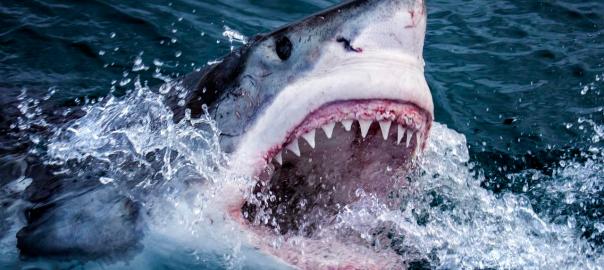
My classes tend towards utilizing a lot of “real-life” happenings in the world.  It is no surprise that one of my favorite labs had the students watching a short clip from the popular television show Mythbusters where the team uses the scientific method to debunk the idea that sharks prefer the color red.  To view the video, click here: SHARKS

I honestly cannot recollect where I got this lesson plan or idea from.  I checked all my files and could only find the excel worksheet where I use the Mythbusters: Do Sharks Prefer Red? as the backdrop for the lesson plan on the Scientific Method.  If anyone out there knows where I found it, I would truly appreciate a comment so I can give the proper credit.

I did create or recreate a worksheet that starts at the lower level of thinking.  First, we just watch the short 4 or 5 minute video clip.  Then, the students answer some basic “what did you see” kind of questions.  Then, the students have to watch the video a second time and more carefully detail the scientific method stages as they are being used in the video using the video itself as evidence.  Following that, the students take to the deeper level and are required to come up with their own myth to bust and design a scientific method experiment to test it.

These types of lessons really engage my students because they are so “into” media: music, video, and who isn’t into sharks?


Learning Styles

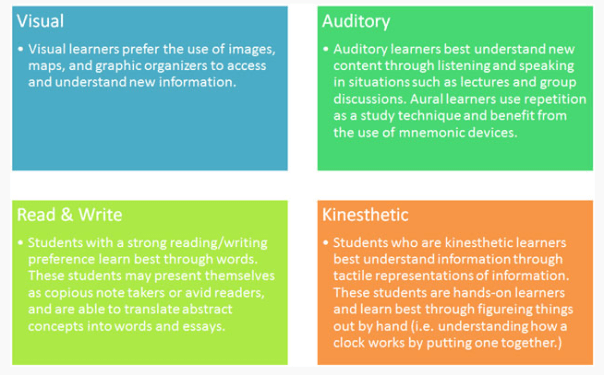
Current research indicates “an individual’s learning style refers to the preferential way in which the student absorbs, processes, comprehends and retains information.”  Essentially, “VARK is an acronym that refers to the four types of learning styles: Visual, Auditory, Reading/Writing Preference, and Kinesthetic.”  Many learning style surveys omit the Reading/Writing Preference leaving it the typical three: visual, auditory, or kinesthetic.  It is important to note, although a student or adult has a preference for one particular style over the other, it is also important that they practice outside their comfort zone because there may be times when their learning style may be constrained by outside forces.

Every teacher should, theoretically, strive to adapt their lesson plans to incorporate each of these four areas as often as possible to ensure all students’ learning modalities are covered. In fact, according to Fleming and Baume (2006):

  • Students’ preferred learning modes have significant influence on their behavior and learning.
  • Students’ preferred learning modes should be matched with appropriate learning strategies.
  • Information that is accessed through students’ use of their modality preferences shows an increase in their levels of comprehension, motivation and metacognition.

“Identifying your students as visual, auditory, reading/writing or kinesthetic learners, and aligning your overall curriculum with these learning styles, will prove to be beneficial for your entire classroom. Allowing students to access information in terms they are comfortable with will increase their academic confidence” (“Learning Styles”, 2017).

Vark

Understanding how they learn best, enables a student to adapt his or her current study habits to include methods previously unrealized as potentially successful.  This can be a real eye-opener to a student who has struggled in school academically simply because they are more kinesthetic and most instruction is given visual or auditory modalities.

In my classes, I often use what I call the Around the Room Learning Lab.  It incorporate eight different learning stations: Read It! Write It! Explore It! Organize It! Watch It! Research It! Assess It! Illustrate It! and Write It!.  Credit for this goes to Chris Kesler on Teacher Pay Teachers who introduced me to this idea.  I have used many of his labs, and having become familiar with them, have been redesigning them to incorporate deeper cognitive questions and/or thinking, or to emphasize a different aspect of the content.  Mr. Kesler does an amazing job in creating these learning labs, which are great at getting the students familiar with the facts, simple DOK levels 1 and 2 information.  I have been redesigning some of them to incorporate more DOK 3 and 4 levels of thinking.  What is especially great about the labs is that the students are moving around, collaborating, discussing academic concepts, reading academic material, watching academic videos, and illustrating their visualization of academic content.

Once the students have gone through the basics, I am ready to put them through the paces with a scientific lab set up requiring a hypothesis, materials, procedures, data analysis, and results.

Works Cited

Fleming, N., and Baume, D. (2006) Learning Styles Again: VARKing up the right tree!, Educational Developments, SEDA
Ltd, Issue 7.4, Nov. 2006, p4-7.

Learning Styles. (2017). Retrieved March 25, 2017, from https://teach.com/what/teachers-teach/learning-styles/

Othman, N., & Amiruddin, M. H. (2010). Different Perspectives of Learning Styles from VARK Model. Procedia – Social and Behavioral Sciences, 7, 652-660. doi:10.1016/j.sbspro.2010.10.088