Category Archives: Geoscience

Big Music Experiment

As a comprehensive performance task, the students were given the task of creating, and running a music experiment investigating whether music with words, music without words, or no music (control group) would do better at a comprehension task, as well as retention task.

It was a nifty set-up.  I randomized the students with an online generator to put students in the control group, five students in the Condition 1 group (music with lyrics), five students in the Condition 2 group (music without lyrics) and the remaining students were the scientist/leader, data analyzer, etc. for their group.

The materials included:

  • five blue thumb drives with 8 songs with lyrics 
  • five blue thumb drives with 8 songs without lyrics
  • Instructions for Condition 1
  • Instructions for Condition 2
  • Instructions for the control group
  • 10 class chrome books for the two Conditions
  • Data sheets
  • Articles for the students to read in each condition, and keys provided to scientist/leader of each group.
  • Timer

Results

Unfortunately, the results were rather inconclusive.  With such small condition groups, it was difficult to generalize the results.  In addition, many of the students were game for the first half of the experiment, but did not put very much effort into the second half of the experiment regarding data analysis, research, and drawing scientific conclusions.

Other issues with the experiment included an extremely small sample size.  For this experiment to be truly accurate it would have to have been conducted across all five of my classes, with the classes each divided into thirds.  As I am currently teaching three separate types of classes, we had neither the technological resources, nor the student resources to complete the experiment properly.

It was successful in that the students realized how much effort goes into making an experiment work and how little it takes to make it inaccurate.  They also showed much more interest because the experiment was about a topic they have a vested interest in – listening to music while they work.  Despite the research to the contrary, many still insist they do much better when listening to music.  It is true there are always outliers, but so far the only exception to the musical rule of thumb is music without lyrics, or music in either form when performing mathematical computations.
Work for a Cause

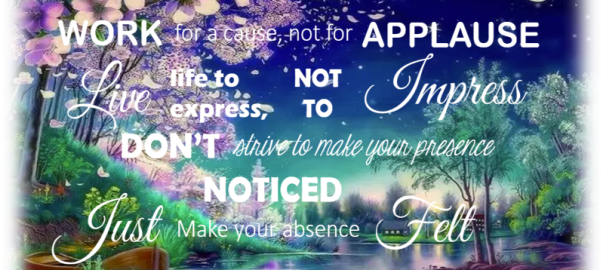
This particular quote is difficult for many teens to really understand deeply, cognitively, and emotionally.  Teens are at the awkward stage of life where they believe everything they do is being watched, judged, and/or criticized – not just by parents, teachers, and other authority figures, but worse than that – their “friends.”

This was a journal prompt I have used in both science classes and health classes because it serves multiple purposes.  First, the students have to really decode the message.  Most of the time they ask me to explain it without even trying, but I always make them to some time and really think about their lives and how this sentiment applies.

Most of my students will get to the cognitive meaning of the quote because they believe it is like a right or wrong question; they do not yet understand that it is not about being right or wrong, it is about building a philosophy for existence.  It is about self-esteem, belief in your inner self, no matter what anyone else thinks.

My favorite analogy is the story of my four-year-old son who wanted to get his nails polished for preschool because mommy and auntie were getting their nails polished.  Gabriel was so excited.  He picked out a really nice green for both his hands and his toes.  His smile lit the room.  When we went home, my husband pulled me aside and was so worried about my undermining our son’s masculinity.  What if he always wants to wear nail polish and then, what if he wants to wear lipstick . . . oh, my.  He was panicked.  I reassured him we would never have to worry about such things.

I cannot be sure what occurred at preschool the next day, but my beautiful son came home at 11:30 a.m. with absolutely no green nail polish on his fingers.  We had a first talk about individuality and the importance of “owning” who you are.  He had literally eaten off his nail polish from his fingers.  I can imagine the other children were pretty harsh, perhaps even a couple of the teachers as well because despite the literal TONS of famous eccentric individuals out in the world, in the every day life of an every day person, it is NOT okay to be different – our social norms dictate that being different is somehow “wrong?”

This when my teens really start to understand the depth of the message because they realize from this simple story how much of life is just like that, as if we are all square meant to fit in square spaces.  But some of us are MORE.  I AM different.  I own my differences, even celebrate them.  The students get it.  They are at a time of their life when they want everyone to “see them,” and that is where it gets tricky because I have to explain it is not about rebelling just to rebel, doing something just because you are under scrutiny, it is about doing what is right simply because it is right, even if no one else knows about it.

My students always ask who is my favorite student.  I always tell them how can I possibly have a favorite student, they are all unique, beautiful, and talented, it would be like picking my favorite flower amidst a flower garden of the most amazing, priceless, flowers in the world. Every single student knows I care about them.  No the color of their hair, their sandals, their high A’s or low F’s.  I care because my students are at an age when they need to express themselves, but they also need to be accepted for who they are – and they are still trying to figure that out (sometimes, I am still trying to figure me out too).

Once we have reached that depth behind the quote, they are in the cognitive zone for critical thinking, creative thinking, abstract thinking . . . exactly where I need them to be while we discuss science content.  The students need to see the big picture, the little picture, and the phases in-between.  It requires them to think beyond the simple facts you can google, and delve into the phenomena of why something occurs, how it is connected to our planet, earth, and life.  I just use journals to get the students in the right mental perspective, as well as teaching them a little bit about character and citizenship.


Gemklocx Lab

Thank you AVID Science 1, a summer conference I took recently.  This was a wonderfully ingenious lab I did with my Geoscience students, both periods 1 and 2.  It does require quite a bit of set-up and some rather ordinary materials.  Once you are organized, it works out great, as long as the students follow the rules of the lab.

Materials:

  • 2 small paper plates
  • 4 twist ties
  • 2 straws
  • Aluminum foil 12 x 12
  • 1 small paper cup
  • 2 paper clips
  • 3 rubber bands
  • 1 sheet of paper
  • 8 cm of tape

Procedures

The students each received a handout (provided by AVID)  Think It-Build It-Write It-The Gemklocx, which explained the procedure, in addition to the PowerPoint and my oral directions.

There were two main parts of the lab, which is designed to teach students the importance of following EXACT procedures during lab experiments.

First, each student partners with another student forming a team.  Each team receives one set of materials to create and build a model of their own originality.  The time limit is 20 minutes.  At the same time, each team MUST record their procedure, item by item so that the next team can recreate their EXACT model without being able to see it.  All materials must be used and the students were not allowed to add any materials.

Second, the teams were told to hide their models so the other teams could not see them.  Each team was given the exact same materials as previously in addition to the written procedures provided by one of the random teams.  These teams had only 10 minutes to recreate the original model of the first team.

It was one of the best labs.  It was early in the year, and the students were so engaged in the entire process.  They loved created something their own.  Their follow-up reflections regarding the lab concept, procedures, ease and/or difficulty revealed the majority of the students believed the writing of the procedures specific enough for another team to follow was, indeed, the most difficult part.  I look forward to doing it again next year.

Do Sharks Prefer Red?

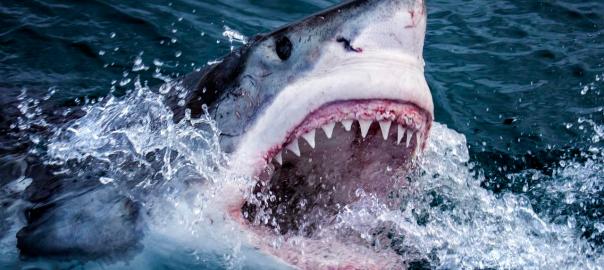
My classes tend towards utilizing a lot of “real-life” happenings in the world.  It is no surprise that one of my favorite labs had the students watching a short clip from the popular television show Mythbusters where the team uses the scientific method to debunk the idea that sharks prefer the color red.  To view the video, click here: SHARKS

I honestly cannot recollect where I got this lesson plan or idea from.  I checked all my files and could only find the excel worksheet where I use the Mythbusters: Do Sharks Prefer Red? as the backdrop for the lesson plan on the Scientific Method.  If anyone out there knows where I found it, I would truly appreciate a comment so I can give the proper credit.

I did create or recreate a worksheet that starts at the lower level of thinking.  First, we just watch the short 4 or 5 minute video clip.  Then, the students answer some basic “what did you see” kind of questions.  Then, the students have to watch the video a second time and more carefully detail the scientific method stages as they are being used in the video using the video itself as evidence.  Following that, the students take to the deeper level and are required to come up with their own myth to bust and design a scientific method experiment to test it.

These types of lessons really engage my students because they are so “into” media: music, video, and who isn’t into sharks?


Scientific Method Project

So excited, the students and I had been learning all the different parts of the scientific method, analyzing it, dissecting it, and now it was time to put them in the driver’s seat, so to speak.

Each student had to create their own flow chart poster board describing an experimental process, from title, hypothesis, all the way to conclusions.  It was really exciting.  I provided the following example:

Learning Styles

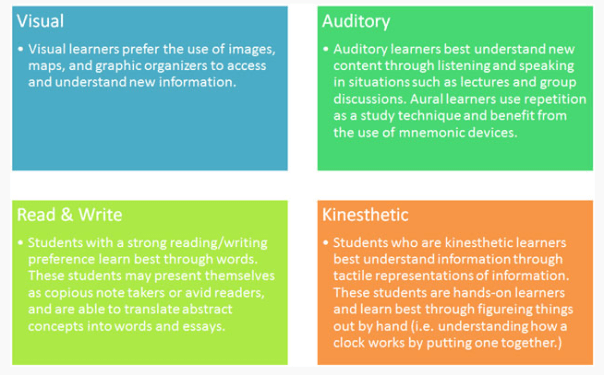
Current research indicates “an individual’s learning style refers to the preferential way in which the student absorbs, processes, comprehends and retains information.”  Essentially, “VARK is an acronym that refers to the four types of learning styles: Visual, Auditory, Reading/Writing Preference, and Kinesthetic.”  Many learning style surveys omit the Reading/Writing Preference leaving it the typical three: visual, auditory, or kinesthetic.  It is important to note, although a student or adult has a preference for one particular style over the other, it is also important that they practice outside their comfort zone because there may be times when their learning style may be constrained by outside forces.

Every teacher should, theoretically, strive to adapt their lesson plans to incorporate each of these four areas as often as possible to ensure all students’ learning modalities are covered. In fact, according to Fleming and Baume (2006):

  • Students’ preferred learning modes have significant influence on their behavior and learning.
  • Students’ preferred learning modes should be matched with appropriate learning strategies.
  • Information that is accessed through students’ use of their modality preferences shows an increase in their levels of comprehension, motivation and metacognition.

“Identifying your students as visual, auditory, reading/writing or kinesthetic learners, and aligning your overall curriculum with these learning styles, will prove to be beneficial for your entire classroom. Allowing students to access information in terms they are comfortable with will increase their academic confidence” (“Learning Styles”, 2017).

Vark

Understanding how they learn best, enables a student to adapt his or her current study habits to include methods previously unrealized as potentially successful.  This can be a real eye-opener to a student who has struggled in school academically simply because they are more kinesthetic and most instruction is given visual or auditory modalities.

In my classes, I often use what I call the Around the Room Learning Lab.  It incorporate eight different learning stations: Read It! Write It! Explore It! Organize It! Watch It! Research It! Assess It! Illustrate It! and Write It!.  Credit for this goes to Chris Kesler on Teacher Pay Teachers who introduced me to this idea.  I have used many of his labs, and having become familiar with them, have been redesigning them to incorporate deeper cognitive questions and/or thinking, or to emphasize a different aspect of the content.  Mr. Kesler does an amazing job in creating these learning labs, which are great at getting the students familiar with the facts, simple DOK levels 1 and 2 information.  I have been redesigning some of them to incorporate more DOK 3 and 4 levels of thinking.  What is especially great about the labs is that the students are moving around, collaborating, discussing academic concepts, reading academic material, watching academic videos, and illustrating their visualization of academic content.

Once the students have gone through the basics, I am ready to put them through the paces with a scientific lab set up requiring a hypothesis, materials, procedures, data analysis, and results.

Works Cited

Fleming, N., and Baume, D. (2006) Learning Styles Again: VARKing up the right tree!, Educational Developments, SEDA
Ltd, Issue 7.4, Nov. 2006, p4-7.

Learning Styles. (2017). Retrieved March 25, 2017, from https://teach.com/what/teachers-teach/learning-styles/

Othman, N., & Amiruddin, M. H. (2010). Different Perspectives of Learning Styles from VARK Model. Procedia – Social and Behavioral Sciences, 7, 652-660. doi:10.1016/j.sbspro.2010.10.088