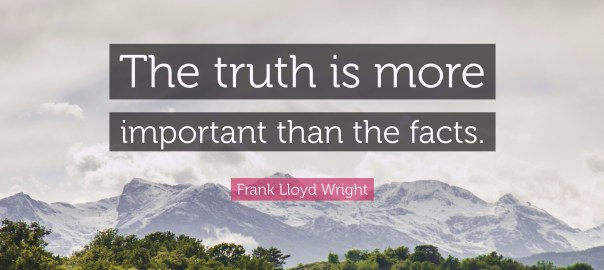
The students struggled mightily with this quote. Some of the more flippant students tried to take the easy way out and claim that the truth is the facts and facts are the truth. Rather than dissuade them immediately, we moved onto on regular science lesson (this was just the journal to capture their mindset).
The rest of class went by without any issues. During the next class I broached the topic again of when it would be possible that the truth is more important than the facts. I prodded them with a few examples because ultimately it becomes about semantics, vocabulary, ethics, character, and even social norms in some instances.
Example 1: A young couple adopts a baby boy, and were then subsequently surprised by their own bundle of joy, a baby girl about a year later. These siblings were raised their entire life as brother and sister, fighting over television shows, arguing through their teens, and enduring puberty as teens attending the same high school. When the girl reaches 18 and the boy just a year older, they decide to run away and elope. Is that okay? Why or why not?
The students were enraged at the idea that this could happen, but I calmly countered with why? They may be legally brother and sister, but biologically they are not. Why does it matter so much? Then, the students realize, they have to look deeper into the meanings of what is really being asked. In this instance, because the children were raised together, their eloping would be a violation of our social norms against incest within the family.
Example 2: Teachers in the hotseat. I ask the students how do they know I am a teacher? Their initial responses are weak and tired. I get paid to teach them. I show up to work every day. I help them learn. So, I query . . . should teachers be compassionate? flexible? kind and generous to the students? come to school voluntarily? passionate about what they are teaching the students that day? Then, I ask them, how many “teachers” are there and how many people are just working a job? How do they know the difference? In this instance, teachers are paid to teach, that is a fact. The truth is that children, teens, and adults have “teachers” in their lives every day, in every way, that are not paid for being “teachers.” In fact, I would argue that some of the most important “teachers” in a student’s life do not have a teaching credential at all.
Now the students are really excited and engaged. They are realizing truth does not always look like facts. Just because a person is paid money for a job does not necessarily mean they are doing their job to the best of their ability, for whatever reason.
Example 3: Students in the hotseat. I ask how many of the students come to school voluntarily? How many would attend if there were no mandatory attendance laws for schooling in this country? How many of the students come prepared, passionate to learn what the teachers have to offer each day? How many of the students go home and google something about their lesson that the teacher did not ask them to do? How many students joyfully prepared for the lesson of the day? How many students spent the night before socializing, texting, skating, boarding, or playing video games instead? How many students stayed up too late not because they had too much homework, but because they did not start their homework until it was already late? The students immediately understood where I was going. They openly confessed that the fact is many of them go to school and “pretend” to be students. The truth is there are many “real” students who enjoy learning and academia; however, the other truth is there are also many students apathetic toward school, and would rather be anywhere else.
It was a great character lesson that morning that only took about 15 minutes.
 Just A Lynn Minute