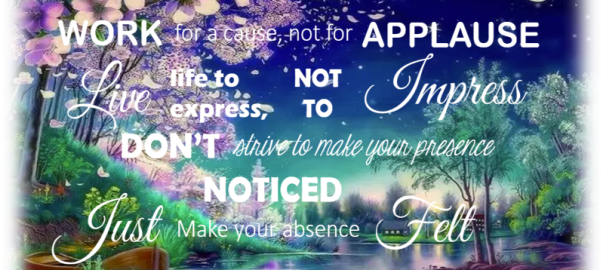
This particular quote is difficult for many teens to really understand deeply, cognitively, and emotionally. Teens are at the awkward stage of life where they believe everything they do is being watched, judged, and/or criticized – not just by parents, teachers, and other authority figures, but worse than that – their “friends.”
This was a journal prompt I have used in both science classes and health classes because it serves multiple purposes. First, the students have to really decode the message. Most of the time they ask me to explain it without even trying, but I always make them to some time and really think about their lives and how this sentiment applies.
Most of my students will get to the cognitive meaning of the quote because they believe it is like a right or wrong question; they do not yet understand that it is not about being right or wrong, it is about building a philosophy for existence. It is about self-esteem, belief in your inner self, no matter what anyone else thinks.
My favorite analogy is the story of my four-year-old son who wanted to get his nails polished for preschool because mommy and auntie were getting their nails polished. Gabriel was so excited. He picked out a really nice green for both his hands and his toes. His smile lit the room. When we went home, my husband pulled me aside and was so worried about my undermining our son’s masculinity. What if he always wants to wear nail polish and then, what if he wants to wear lipstick . . . oh, my. He was panicked. I reassured him we would never have to worry about such things.
I cannot be sure what occurred at preschool the next day, but my beautiful son came home at 11:30 a.m. with absolutely no green nail polish on his fingers. We had a first talk about individuality and the importance of “owning” who you are. He had literally eaten off his nail polish from his fingers. I can imagine the other children were pretty harsh, perhaps even a couple of the teachers as well because despite the literal TONS of famous eccentric individuals out in the world, in the every day life of an every day person, it is NOT okay to be different – our social norms dictate that being different is somehow “wrong?”
This when my teens really start to understand the depth of the message because they realize from this simple story how much of life is just like that, as if we are all square meant to fit in square spaces. But some of us are MORE. I AM different. I own my differences, even celebrate them. The students get it. They are at a time of their life when they want everyone to “see them,” and that is where it gets tricky because I have to explain it is not about rebelling just to rebel, doing something just because you are under scrutiny, it is about doing what is right simply because it is right, even if no one else knows about it.
My students always ask who is my favorite student. I always tell them how can I possibly have a favorite student, they are all unique, beautiful, and talented, it would be like picking my favorite flower amidst a flower garden of the most amazing, priceless, flowers in the world. Every single student knows I care about them. No the color of their hair, their sandals, their high A’s or low F’s. I care because my students are at an age when they need to express themselves, but they also need to be accepted for who they are – and they are still trying to figure that out (sometimes, I am still trying to figure me out too).
Once we have reached that depth behind the quote, they are in the cognitive zone for critical thinking, creative thinking, abstract thinking . . . exactly where I need them to be while we discuss science content. The students need to see the big picture, the little picture, and the phases in-between. It requires them to think beyond the simple facts you can google, and delve into the phenomena of why something occurs, how it is connected to our planet, earth, and life. I just use journals to get the students in the right mental perspective, as well as teaching them a little bit about character and citizenship.
 Just A Lynn Minute