Tag Archives: students

The backbone of every Effective Educator

There really is no secret here.  From my experience, there is no educating or learning occurring if the class is out of control.

Every teacher has to weather this particular storm and find out what truly works for them.  The wisdom of the ages tends to conflict on a few of the finer points.  However, what they all agree on, unanimously, is classroom management is key to successful teaching.

First, a Classroom Management Plan is essential.  This can be tricky if you are new to the school you are at.  For instance, a tenured teacher can get away with simply sending a student out.  Period.  Finito.  They may have their knuckles rapped for “not following procedure,” but that is about it.  Probationary Teachers – either Prob 1 or Prob 2 – are on a little bit more of balancing beam.  The Plan has to include what is and what is not allowed on your school’s campus.  For instance, last year I worked at a school that allowed or tutorial detention.  Awesome.  If the students were misbehaving, before detention, “real detention,” they would receive tutorial detention with me.  Typically, this would require a chat, along with some pointed questions about behavior and goals.  This is quite different from another school site where the students are bused in and out.  There is no after school detention (bus coming).  There is no tutorial.  The students even have separate lunches, so that is not a possibility.

Second, posting your expectations, rules, procedures, and consequences.  This is key as I learned the hard way.  Although the students and parents had signed a syllabus, it was out of sight out of mind.  Although the students had access to the information online through Haiku, it was still out of sight, out of mind.  Emails with parents and counselors did not seem to help.  It was not until I posted the laminated expectations and consequences ON THE WALL, that I finally enjoyed some peace.

This district prefers the term “Expectations,” over rules.  Works for me.  I use a modified version of “Whole Brain Teaching.”  I am quite sure many teachers are aware of it.

  • Expectation #1 – Follow Directions Quickly
  • Expectation #2 – Raise your hand to Speak
  • Expectation #3 – Raise your hand to Leave your Seat
  • Expectation #4 – Make Smart Choices (pretty much the umbrella catch-all)
  • Expectation #5 – Believe in yourselves, because I already do.  (This was my modification). 

My consequences are pretty standard.

  • Consequence #1 – Warning
  • Consequence #2 – Quick Chat After Class
  • Consequence #3 – Email or Phone Home (pun intended)
  • Consequence #4 – Contact counselor
  • Consequence #5 – Detention AND Parent Teacher Conference

To introduce them to the “new” way of things, I surprised the class with a quick get up and move around to the corner on the left side of the room.  The students were excited and all a-twitter.  Then, I simply asked them to do an about-face and read the board in unison.  That part was very important.  They did.  Then, I had them step three steps to the right, and read the consequences in unison.  They did.  I asked if they understood what was going on and they responded they did and some even volunteered that now they had to behave.  Now?  That is on me.

Third is consistency.  Believe me, I did not get peace immediately.  The students had to test me first.  The first day a few students went past the warning to the quick chat.  Only one student opted for the E ticket ride, straight from #1 to #5 within 15 minutes.  When he came back to my class after detention I reminded him that he had a fresh start.  It was water under the bridge.  It was his responsibility to stay on task.  He agreed.

Pretty long blog about something laypeople consider “simple classroom management.”  Personally, the only thing I can compare it to is ministers giving a sermon at church.  Of course, their audience is voluntary, but that is what makes it all the more impressive.  How do ministers inspire so many people to get up early on a Saturday or Sunday, get dressed in their best, and go sit in an auditorium quietly, attentively listening, for as long as the minister wants to speak?  Clearly, I am a church-goer.  We just moved to a new area so it will take us awhile to find our new church.  I need to find a pastor that “touches” my heart, and engages my mind.  Sounds a lot like teaching, doesn’t it?


Student Trust

At my position in Glendora, CA I taught Health Science, Earth Science, and Biology.  Quite frequently I would have many of the same students for Health that I had in one of the science classes.  That was my favorite aspect of being both a Health and Science Teacher.  I was blessed with a chance to really build trust with my students on a frequent basis.  Of course, the Health Science topics did help quite a bit.

As a result of my relationships with the students, I was the go-to gal for many hurting students.  In the last year I was there, I had a student open up and admit to me that he had violent thoughts of hurting others.  He was able to seek treatment.  His father was so thankful I “found” his son.  I had a number of domestic issues that would arise.  Students whose parents were neglectful, or even physically abusive.  I was privy to this invitation and would use my crisis intervention skills (and strong background in Psychology) to talk them down, and then walk them over to counseling.

When I moved to Menifee and began working at Heritage High I was a little sad because I would miss teaching Health.  I truly did not believe the students would believe in me and trust me like at Glendora, CA.

I was wrong.  I teach Biology and Anatomy & Physiology, but somehow most of the students still trust me.  Perhaps, it is my openness and honesty.  The stress these students are under seems insurmountable to them.  Within the last few months I have had a number of students come to me broken down in tears.  I have also received a thinly veiled suicide email, which allowed me to get help for that student, immediately.   There are also countless others who have opened up to me about their anxiety, fears, depression, and stress.  Before school and during first lunch, I have a number of students who come into my classroom.  They are typically very quiet, very respectful, and even put their trash outside in the big trash receptacles because I prefer no food substances left in class.  These students have a found a safe place, a peaceful place, to enjoy their lunch without being judged, manipulated, or even having to deal with peer pressure.  They can just enjoy feeling safe for a short time.

My husband often asks me if I tell other teachers, or the administration of these many incidents.  He wants me to somehow benefit from these acts of compassion.  I have to remind him again and again (he can be quite stubborn), that these students are the benefit.  I do not need glory and applause.  I helped someone in need, and that is the best blessing of all.

Using Quizizz in Class . . . a Review

Today was the first day I had ever used Quizizz in class.  I made up several of these to engage the students in review for the next two weeks.  But, today was a trial run so I made a Quizizz based on class expectations and consequences.  Then, I piggybacked another practice Think . Pair . Share with the classes about the game site.

Pros: The game is easy to set up, copy questions and answers and finish.  It also has several positive features such as timer on/off, memes on/off, randomizing questions and answers, providing feedback, review for answers, and my favorite, a leader board.  The leader board helped the students see how they were doing.  We were able to review the questions an answers at the end.

Cons:  Students are much less familiar with Quizizz than Kahoot.  Although selected to work, the music would not play.  The print is very tiny (even on a projector) for the information on how to join the game, and the code number.

To be able to compare it to Kahoot, I will experiment with Kahoot tomorrow.  I have a Biology Quizizz I had previously created, but I will convert it into Kahoot and provide a comparison for final review.


AVID Summer Institute

I have been very fortunate to have attended AVID Summer Institute, not once, but two summers in a row.

The first summer I was registered for Science I, which was a great match because I was teaching Earth Science, Biology, and Health Science.  I learned so much.  I incorporated a great many AVID strategies that year, including the interactive science notebook.  It was my first year using one; there was a steep learning curve.

That was the first year I ran a Gemklocx lab for procedures and fell in love.  Hands-on, collaborative, and fell perfectly within the scientific method unit.  It helped meet the students’ learning goals for understanding the importance of following procedures.

In June, 2017 Heritage High hired me to teach Anatomy and Physiology, and Biology.  What I did not realize at the time was that Heritage High is a demo school for AVID, which I have been actively trying to use their strategies in the classroom.  It has been truly impressive to see teachers school-wide on board with AVID strategies.

Heritage High graciously sent me to summer institute where I was registered to attend Student Success.  Another terrific series.  Again, the strategies were amazing, some review and some new.  I have implemented many this year.  I use a Student Choice series of strategies from AVID that students use to choose how they want to express their understanding of a topic.  I also use Learning Logs, Quickwrites, Reflections, and just recently graduated to Philosophical Chairs.  After the Philosophical Chairs (rough draft – first time), at least one student from each class asked if we could do more of them.

I indicated to the students I was in the process of gaining access to a Science Case Study database, so it is very likely we would be doing them more in the future.

Students’ Comments

I created this page because over the years, I have received such wonderful praise from my students and believe not only do they deserve a shout-out for being amazing teens, but I wanted to share their passion with others.  Many people believe students are apathetic and do not care, but I am passionate about teaching, inspired to create lifelong learners out of every single one of my students.  No matter what occurs on any one day, I come back the next with a new idea, lesson, or “out of the box” idea to try the next day.  It would seem that it has been working.  Plus, as I have told my students ad nauseum, I am a work in progress, I will never be “finished” or “done” learning how to be a good  teacher.  So, any positive or negative feedback is welcome.

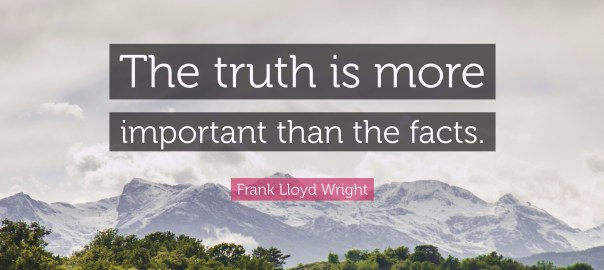
Truth

The students struggled mightily with this quote.  Some of the more flippant students tried to take the easy way out and claim that the truth is the facts and facts are the truth.  Rather than dissuade them immediately, we moved onto on regular science lesson (this was just the journal to capture their mindset).

The rest of class went by without any issues.  During the next class I broached the topic again of when it would be possible that the truth is more important than the facts.  I prodded them with a few examples because ultimately it becomes about semantics, vocabulary, ethics, character, and even social norms in some instances.

Example 1: A young couple adopts a baby boy, and were then subsequently surprised by their own bundle of joy, a baby girl about a year later.  These siblings were raised their entire life as brother and sister, fighting over television shows, arguing through their teens, and enduring puberty as teens attending the same high school.   When the girl reaches 18 and the boy just a year older, they decide to run away and elope.  Is that okay? Why or why not?  

The students were enraged at the idea that this could happen, but I calmly countered with why?  They may be legally brother and sister, but biologically they are not.  Why does it matter so much?  Then, the students realize, they have to look deeper into the meanings of what is really being asked.  In this instance, because the children were raised together, their eloping would be a violation of our social norms against incest within the family.

Example 2: Teachers in the hotseat.  I ask the students how do they know I am a teacher? Their initial responses are weak and tired.  I get paid to teach them.  I show up to work every day.  I help them learn.  So, I query . . . should teachers be compassionate? flexible? kind and generous to the students? come to school voluntarily? passionate about what they are teaching the students that day?  Then, I ask them, how many “teachers” are there and how many people are just working a job?  How do they know the difference?  In this instance, teachers are paid to teach, that is a fact.  The truth is that children, teens, and adults have “teachers” in their lives every day, in every way, that are not paid for being “teachers.”  In fact, I would argue that some of the most important “teachers” in a student’s life do not have a teaching credential at all.

Now the students are really excited and engaged.  They are realizing truth does not always look like facts.  Just because a person is paid money for a job does not necessarily mean they are doing their job to the best of their ability, for whatever reason.

Example 3: Students in the hotseat.  I ask how many of the students come to school voluntarily?  How many would attend if there were no mandatory attendance laws for schooling in this country?  How many of the students come prepared, passionate to learn what the teachers have to offer each day?  How many of the students go home and google something about their lesson that the teacher did not ask them to do?  How many students joyfully prepared for the lesson of the day?  How many students spent the night before socializing, texting, skating, boarding, or playing video games instead?  How many students stayed up too late not because they had too much homework, but because they did not start their homework until it was already late?  The students immediately understood where I was going.  They openly confessed that the fact is many of them go to school and “pretend” to be students.  The truth is there are many “real” students who enjoy learning and academia; however, the other truth is there are also many students apathetic toward school, and would rather be anywhere else. 

It was a great character lesson that morning that only took about 15 minutes.


truth is powerful

Change Yourself

Another growth mindset embedded in a famous quote that urges everyone, teens and adults, to own their lives . . . truly own them.  There is rarely a fairy godmother, fairy dust, or a prince charming to rescue us from the lives we have to live.  There are so many things we truly cannot change,  It is because of this very sentiment that I push my students to strongly consider this deeply.  I ask them lots of deep questions . . . What do you want for your life?  Are you on your way to achieving your goals?  I remind them frequently, we have to take responsibility for our choices: good, bad, or ugly.  I discuss character frequently as well. Honesty, loyalty, integrity, truth, kindness, generosity, and respect for others.

These are traits within ourselves that we can control and pay forward.  I probably give more personal examples than most, but I’ve lived through a lot of unique circumstances that really cause the students to “get it.”  For instance, they will remark that “everything has a reason.”  To which, I easily respond what would be the reason behind losing my youngest son?  They believe they are honest, but when I inquire if they lie to their parents, they are quick to say “that’s different.”  I explain how it is not different.  When one student calls another one a bad word, name, or hurts their feelings, it is not tolerated, not in my class.  In my class, we are kind, respectful and generous to each other.  If you cannot follow those rules, then you will be sent out of the class because everyone is valuable.

It is different again generationally.  My generation took on all the responsibility and to this day, even when I bear no fault, I feel guilty if one of my students suffer, or does not do well.  Sometimes, empathy and compassion can be difficult when you care so much for 180 students a year.

Big Music Experiment

As a comprehensive performance task, the students were given the task of creating, and running a music experiment investigating whether music with words, music without words, or no music (control group) would do better at a comprehension task, as well as retention task.

It was a nifty set-up.  I randomized the students with an online generator to put students in the control group, five students in the Condition 1 group (music with lyrics), five students in the Condition 2 group (music without lyrics) and the remaining students were the scientist/leader, data analyzer, etc. for their group.

The materials included:

  • five blue thumb drives with 8 songs with lyrics 
  • five blue thumb drives with 8 songs without lyrics
  • Instructions for Condition 1
  • Instructions for Condition 2
  • Instructions for the control group
  • 10 class chrome books for the two Conditions
  • Data sheets
  • Articles for the students to read in each condition, and keys provided to scientist/leader of each group.
  • Timer

Results

Unfortunately, the results were rather inconclusive.  With such small condition groups, it was difficult to generalize the results.  In addition, many of the students were game for the first half of the experiment, but did not put very much effort into the second half of the experiment regarding data analysis, research, and drawing scientific conclusions.

Other issues with the experiment included an extremely small sample size.  For this experiment to be truly accurate it would have to have been conducted across all five of my classes, with the classes each divided into thirds.  As I am currently teaching three separate types of classes, we had neither the technological resources, nor the student resources to complete the experiment properly.

It was successful in that the students realized how much effort goes into making an experiment work and how little it takes to make it inaccurate.  They also showed much more interest because the experiment was about a topic they have a vested interest in – listening to music while they work.  Despite the research to the contrary, many still insist they do much better when listening to music.  It is true there are always outliers, but so far the only exception to the musical rule of thumb is music without lyrics, or music in either form when performing mathematical computations.

Do Sharks Prefer Red?

My classes tend towards utilizing a lot of “real-life” happenings in the world.  It is no surprise that one of my favorite labs had the students watching a short clip from the popular television show Mythbusters where the team uses the scientific method to debunk the idea that sharks prefer the color red.  To view the video, click here: SHARKS

I honestly cannot recollect where I got this lesson plan or idea from.  I checked all my files and could only find the excel worksheet where I use the Mythbusters: Do Sharks Prefer Red? as the backdrop for the lesson plan on the Scientific Method.  If anyone out there knows where I found it, I would truly appreciate a comment so I can give the proper credit.

I did create or recreate a worksheet that starts at the lower level of thinking.  First, we just watch the short 4 or 5 minute video clip.  Then, the students answer some basic “what did you see” kind of questions.  Then, the students have to watch the video a second time and more carefully detail the scientific method stages as they are being used in the video using the video itself as evidence.  Following that, the students take to the deeper level and are required to come up with their own myth to bust and design a scientific method experiment to test it.

These types of lessons really engage my students because they are so “into” media: music, video, and who isn’t into sharks?


Growth Mindsets

Growth Mindsets is a very hot topic in education these days.  Essentially, individuals who believe they have the power to improve their lives, education, skill sets, and relationships have an open/growth mindset.  Something good happens and it the result of good old-fashioned hard work.  It was not luck.  It was not because they are geniuses (although there are some super-bright individuals in the world).  No.  It is because that personally legitimately decided to put in the effort, follow up, and if that did not do the trick, they sought help.  Eventually, the individual knows they can and will succeed.

This is applicable to everything; at this time I am not an excellent drawing artist.  That does not mean I cannot get better.  I can purchase some books, some artistry tools, watch some online tutorials, or even find a mentor.  Will I ever paint or draw a Picasso?  Probably not, but I bet I could become a pretty good artist.

On the other hand, Fixed Mindsets are very common as well.  These individuals believe that to be good, really good at something (sports, academics, finances, etc.), they need to be talented or blessed with God-given gifts.  If a student gets straight A’s it is diminished by those who consider it due to natural ability.  Students work hard, study harder, and have real strategies for doing well in their courses.  Consider for a second, baseball players in the major leagues.  If a person identifies one of the baseball players as just lucky, being in the right place at the right time, it sort of diminishes all of the hard work a baseball career requires, doesn’t it?

Unfortunately, for those that believe you either have it or you don’t, life can be very hard indeed.

Myself, I had a growth mindset before the phrase was even coined.  One of my personal experiences using a growth mindset, without even realizing it, occurred when I was only 15, going into my second semester of my junior year at Westminster High School.  I had moved a lot as a kid, but my parents managed to keep me in the same school district from 7th to 12th grade.  I tested highly in almost everything and was put in the honors/AP tract.  My eighth grade math teacher was not particularly impressed with my math grade in 8th grade.  Of course, I sat in the back, did not wear my glasses, and rarely understood what she was saying.  I did not dwell.  Based on the teacher’s recommendation, I was put in Algebra A, B, C, D.  Each took one semester equivalent to my freshman and sophomore years in High School.  Mind you, all the rest of my classes were honors and AP and I was getting good grades in everything.

When school restarted after Christmas break in my Junior year, many of friends in the honors or AP classes were all lit up about being a “Distinguished Scholar.”  I did not know what this was, and I did not know why I was not in the know.  Being forthright, even then, I went to my academic counselor and asked what was going on with this Distinguished Scholar award, as it was apparently a “big” deal.  I was told I would not and could not graduate with that honor.  You see, only students who took the honors/AP courses AND successfully passed pre-calculus as a Senior could earn the award.  The counselor essentially told me it was an impossibility because as a Junior I was taking Geometry.  As a Senior I would go on to Algebra 2.

I did not even think twice about it.  I asked her to explain exactly what would have to happen for me to earn the award.  She was pretty negative about the idea, but indicated if I took Algebra 2 at the local junior college and passed with an A, and took Trigonometry over the summer at the junior college and passed it with an A, she would agree to put me in Pre-Calculus as a Senior.

That is exactly what I did!  In fact, Algebra 2 at the college was so easy.  I struggled more with Geometry.  Trigonometry was a hoot.  I still remember taking the bus to the beach after my morning class at Goldenwest College.  I brought my Trigonometry book, studied, and successfully passed.  In fact, I passed both of the classes with an “A.”  Pre-calculus was super hard.  My best friend, Mina, tutored me that year and I passed with a C for both semesters, but I passed!  On a side note, because I took those two math classes at a junior college, I did not have to take math in college for my Bachelor’s degree.  Cool, right?