Tag Archives: Teacher

The backbone of every Effective Educator

There really is no secret here.  From my experience, there is no educating or learning occurring if the class is out of control.

Every teacher has to weather this particular storm and find out what truly works for them.  The wisdom of the ages tends to conflict on a few of the finer points.  However, what they all agree on, unanimously, is classroom management is key to successful teaching.

First, a Classroom Management Plan is essential.  This can be tricky if you are new to the school you are at.  For instance, a tenured teacher can get away with simply sending a student out.  Period.  Finito.  They may have their knuckles rapped for “not following procedure,” but that is about it.  Probationary Teachers – either Prob 1 or Prob 2 – are on a little bit more of balancing beam.  The Plan has to include what is and what is not allowed on your school’s campus.  For instance, last year I worked at a school that allowed or tutorial detention.  Awesome.  If the students were misbehaving, before detention, “real detention,” they would receive tutorial detention with me.  Typically, this would require a chat, along with some pointed questions about behavior and goals.  This is quite different from another school site where the students are bused in and out.  There is no after school detention (bus coming).  There is no tutorial.  The students even have separate lunches, so that is not a possibility.

Second, posting your expectations, rules, procedures, and consequences.  This is key as I learned the hard way.  Although the students and parents had signed a syllabus, it was out of sight out of mind.  Although the students had access to the information online through Haiku, it was still out of sight, out of mind.  Emails with parents and counselors did not seem to help.  It was not until I posted the laminated expectations and consequences ON THE WALL, that I finally enjoyed some peace.

This district prefers the term “Expectations,” over rules.  Works for me.  I use a modified version of “Whole Brain Teaching.”  I am quite sure many teachers are aware of it.

  • Expectation #1 – Follow Directions Quickly
  • Expectation #2 – Raise your hand to Speak
  • Expectation #3 – Raise your hand to Leave your Seat
  • Expectation #4 – Make Smart Choices (pretty much the umbrella catch-all)
  • Expectation #5 – Believe in yourselves, because I already do.  (This was my modification). 

My consequences are pretty standard.

  • Consequence #1 – Warning
  • Consequence #2 – Quick Chat After Class
  • Consequence #3 – Email or Phone Home (pun intended)
  • Consequence #4 – Contact counselor
  • Consequence #5 – Detention AND Parent Teacher Conference

To introduce them to the “new” way of things, I surprised the class with a quick get up and move around to the corner on the left side of the room.  The students were excited and all a-twitter.  Then, I simply asked them to do an about-face and read the board in unison.  That part was very important.  They did.  Then, I had them step three steps to the right, and read the consequences in unison.  They did.  I asked if they understood what was going on and they responded they did and some even volunteered that now they had to behave.  Now?  That is on me.

Third is consistency.  Believe me, I did not get peace immediately.  The students had to test me first.  The first day a few students went past the warning to the quick chat.  Only one student opted for the E ticket ride, straight from #1 to #5 within 15 minutes.  When he came back to my class after detention I reminded him that he had a fresh start.  It was water under the bridge.  It was his responsibility to stay on task.  He agreed.

Pretty long blog about something laypeople consider “simple classroom management.”  Personally, the only thing I can compare it to is ministers giving a sermon at church.  Of course, their audience is voluntary, but that is what makes it all the more impressive.  How do ministers inspire so many people to get up early on a Saturday or Sunday, get dressed in their best, and go sit in an auditorium quietly, attentively listening, for as long as the minister wants to speak?  Clearly, I am a church-goer.  We just moved to a new area so it will take us awhile to find our new church.  I need to find a pastor that “touches” my heart, and engages my mind.  Sounds a lot like teaching, doesn’t it?


Fair v. Equal

Last week my students in Health cried out in despair at the thought that one student was being treated less “equally” as another.  I brought up the discussion of fair v. equal and after a few minutes it became rather clear that as teens, they were having a difficult time understanding the dilemma associated with these terms.  So, I created a reflective piece for them to consider.  There were multiple scenarios provided and they needed to pick out which would be “fair” and which would be “equal.”  Following that was a series of questions, that I hoped would be considered and answered thoughtfully.  A copy of the assignment is attached for reference purposes (fair-v-equal)

One of my responsibilities as a Health instructor of young 9th grade teens is to impart upon them critical thinking, empathy, perspective, decision-making skills, and responsibility in all things health-related.  All things health-related is pretty expansive and stretches far beyond abstinence from sex, drugs, and other risky behaviors.  Teaching tolerance and understanding are probably the most difficult concepts for concrete teens to wrap their minds around.  They very often do not see the consequences of their decisions or actions until they are experiencing them.  I remember vividly my black and white concrete thinking of my teen years all too well.

Fair

Merriam-Webster defines “fair” in no fewer than ten different ways; most relevant to this post are: “6(a) marked by impartiality and honesty : free from self-interest, prejudice, or favoritism; (b): conforming with the established rules : allowed; 10 sufficient but not ample : adequate.”

Equal

Merriam-Webster defines “equal” in quite a number of ways as well.  Those most relevant to this post are: “(1)(a) : of the same measure, quantity, amount, or number as another (2)(a) : equivalent; (b) : like in quality, nature, or status; (c) like for each member of a group, class, or society; (3) regarding or affecting all objects in the same way : impartial.”

The responses I received were varied, but the gist was that they still believed that life should be equal over fair seemingly because if one person gets treated one way, they want to be treated that way as well.  Yet, when faced with a negatively equal situation, they were quite quick to jump over to the fair side of things.  Sadly, few took the time to consider the many significant considerations that impact whether life is “fair” or “equal.”  For instance, they were quick to argue only students who misbehave should receive punishment in a class, yet they refuse to come forward and report to the teacher who the jokester kids are out of blind loyalty to their peers, leaving the teacher with few all or none equal options, rather than the preferable fair options.

Further, the students have not quite connected with the reality of how deeply some beliefs run, preventing fair or equal treatment for all.  For example, consider the inequality in pay for women v. men.  According to The Gender Wage Gap: 2015; Annual Earnings Differences by Gender, Race, and Ethnicity – See more at: http://www.iwpr.org/publications/pubs/the-gender-wage-gap-2015-annual-earnings-differences-by-gender-race-and-ethnicity#sthash.tBFSYiPv.dpuf:

The ratio of women’s and men’s median annual earnings was 79.6 percent for full-time/year-round workers in 2015. This means the gender wage gap for full-time/year-round workers is 20.4 percent. The ratio of women’s and men’s median annual earnings did not improve significantly during the last year, and has not seen a statistically significant annual increase since 2007.

Economy is another primary consideration that is often unconsidered by teens because they have as yet the experience of pinching pennies to pay this bill or that over something they desire more.  They often still believe money simply arrives like magic from atm machines and there is some never-ending supply for everyone, except them of course. Sometimes this is because the parents are still sheltering the teens from the harsher realities of financial responsibility and sometimes, they are fortunate that they do not have very harsh financial realities.

Interestingly, none of the students to date, even looked up the terms for comparison.  When I began grading their responses this evening, I found myself unable to put in comments playing devil’s advocate to their scenarios – poking holes in their tidy black and white thinking.  I am very fortunate to teach health because so much of life revolves around our social, physical, and mental/emotional health.  Plus, it is just plain fun to provide numerous “real” examples that become teachable moments almost every day.  I have as yet to have any student of mine say they did not learn a tremendous amount in my class, despite the fact that I am neither an easy “A,” and I require them to do multiple research-type projects.  By the end of the semester, they have come to realize that Health was probably one of the most important foundational classes they have or will ever take… not to mention the potential for saving their lives, many times over.

Works Cited

Equal. (n.d.). Retrieved February 1, 2017, from https://www.merriam-webster.com/dictionary/equal

Fair. (n.d.). Retrieved February 1, 2017, from https://www.merriam-webster.com/dictionary/fair

Hegewisch, A., & DuMonthier, A. (2016, September). IWPR Publication. Retrieved February 01, 2017, from http://www.iwpr.org/publications/pubs/the-gender-wage-gap-2015-annual-earnings-differences-by-gender-race-and-ethnicity

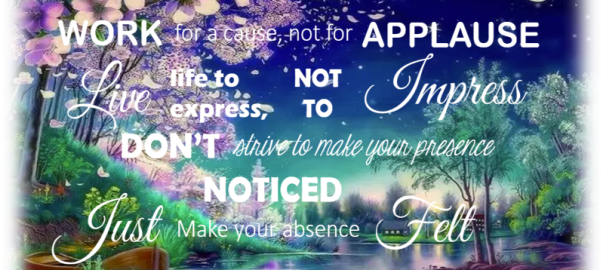
Work for a Cause

This particular quote is difficult for many teens to really understand deeply, cognitively, and emotionally.  Teens are at the awkward stage of life where they believe everything they do is being watched, judged, and/or criticized – not just by parents, teachers, and other authority figures, but worse than that – their “friends.”

This was a journal prompt I have used in both science classes and health classes because it serves multiple purposes.  First, the students have to really decode the message.  Most of the time they ask me to explain it without even trying, but I always make them to some time and really think about their lives and how this sentiment applies.

Most of my students will get to the cognitive meaning of the quote because they believe it is like a right or wrong question; they do not yet understand that it is not about being right or wrong, it is about building a philosophy for existence.  It is about self-esteem, belief in your inner self, no matter what anyone else thinks.

My favorite analogy is the story of my four-year-old son who wanted to get his nails polished for preschool because mommy and auntie were getting their nails polished.  Gabriel was so excited.  He picked out a really nice green for both his hands and his toes.  His smile lit the room.  When we went home, my husband pulled me aside and was so worried about my undermining our son’s masculinity.  What if he always wants to wear nail polish and then, what if he wants to wear lipstick . . . oh, my.  He was panicked.  I reassured him we would never have to worry about such things.

I cannot be sure what occurred at preschool the next day, but my beautiful son came home at 11:30 a.m. with absolutely no green nail polish on his fingers.  We had a first talk about individuality and the importance of “owning” who you are.  He had literally eaten off his nail polish from his fingers.  I can imagine the other children were pretty harsh, perhaps even a couple of the teachers as well because despite the literal TONS of famous eccentric individuals out in the world, in the every day life of an every day person, it is NOT okay to be different – our social norms dictate that being different is somehow “wrong?”

This when my teens really start to understand the depth of the message because they realize from this simple story how much of life is just like that, as if we are all square meant to fit in square spaces.  But some of us are MORE.  I AM different.  I own my differences, even celebrate them.  The students get it.  They are at a time of their life when they want everyone to “see them,” and that is where it gets tricky because I have to explain it is not about rebelling just to rebel, doing something just because you are under scrutiny, it is about doing what is right simply because it is right, even if no one else knows about it.

My students always ask who is my favorite student.  I always tell them how can I possibly have a favorite student, they are all unique, beautiful, and talented, it would be like picking my favorite flower amidst a flower garden of the most amazing, priceless, flowers in the world. Every single student knows I care about them.  No the color of their hair, their sandals, their high A’s or low F’s.  I care because my students are at an age when they need to express themselves, but they also need to be accepted for who they are – and they are still trying to figure that out (sometimes, I am still trying to figure me out too).

Once we have reached that depth behind the quote, they are in the cognitive zone for critical thinking, creative thinking, abstract thinking . . . exactly where I need them to be while we discuss science content.  The students need to see the big picture, the little picture, and the phases in-between.  It requires them to think beyond the simple facts you can google, and delve into the phenomena of why something occurs, how it is connected to our planet, earth, and life.  I just use journals to get the students in the right mental perspective, as well as teaching them a little bit about character and citizenship.